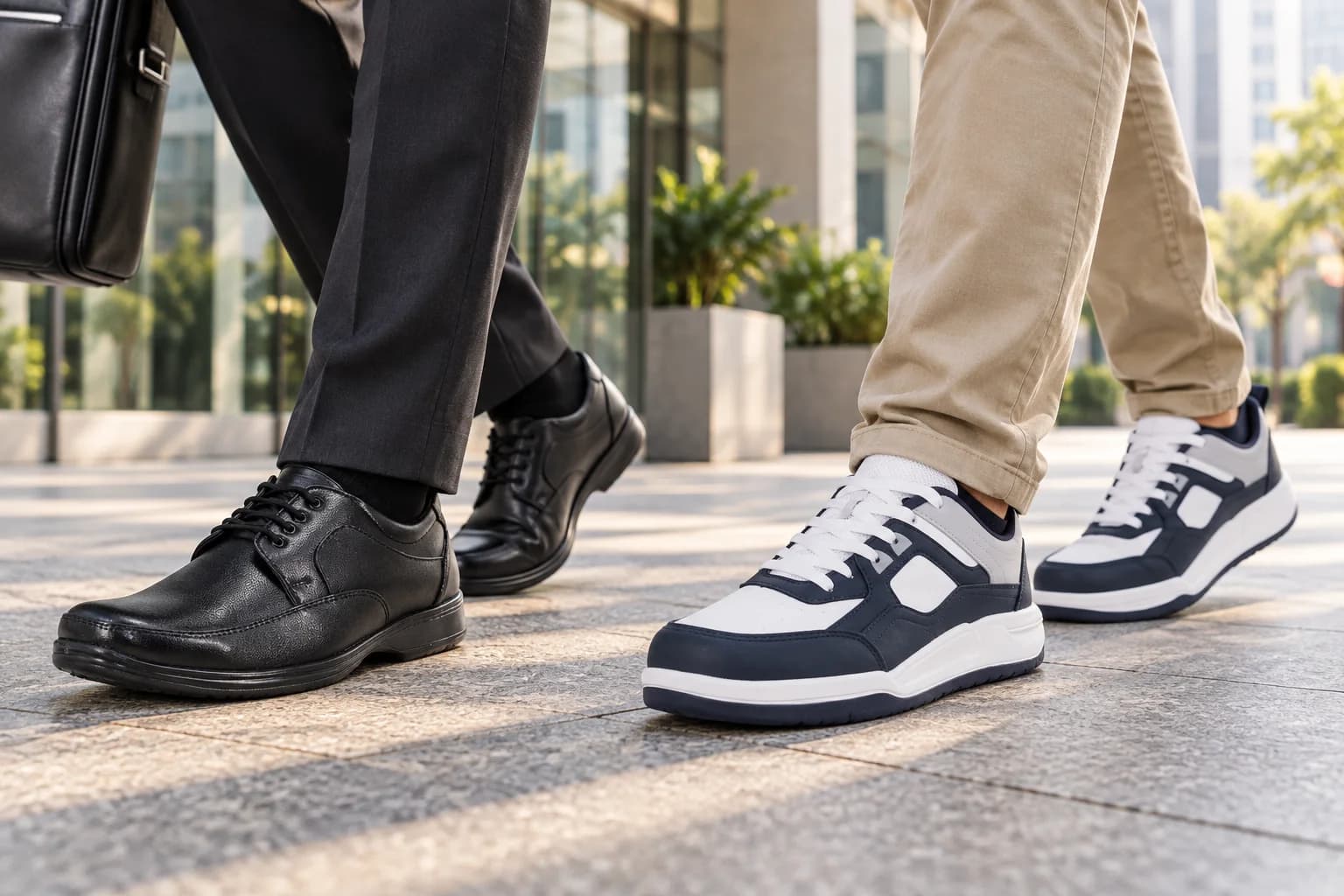
PU Sole vs Rubber Sole: Which Is Better for Daily Wear Shoes?
Polyurethane (PU) and rubber are widely used in shoe soles, but the material label alone does not tell buyers which pair will be more comfortable or durable. Formulation, density, tread, thickness, construction and storage conditions all influence performance.
PU is often selected for low weight and cushioning potential. Rubber is commonly valued for abrasion resistance and traction potential. Neither material is automatically best for every surface or routine, and no sole should be described as slip-resistant without relevant product-specific evidence.
What Are PU Soles and Rubber Soles?
PU is a family of polymer materials that can be formulated into foams or more compact structures. In footwear, it may be used as a single sole unit or as one layer within a multi-part sole. Its density and firmness can be adjusted for different designs.
Rubber soles may use natural rubber, synthetic rubber or blends. They can be moulded with different tread patterns and compounds. A soft, high-friction compound behaves differently from a hard, wear-focused one, even though both are described as rubber.
Buyers should distinguish the outsole from the midsole. A shoe may use a PU midsole for cushioning and a rubber outsole in contact with the ground. Product specifications should identify which component uses which material.
How Are PU and Rubber Soles Manufactured?
PU components can be created through moulding processes in which reactive materials form the required shape and cellular structure. Direct-injection methods may form the sole onto the upper, while other constructions use a separately moulded unit that is attached later.
Rubber compounds are mixed with additives, shaped in a mould and cured to develop their final properties. Manufacturers can vary tread geometry, hardness and thickness according to intended use.
Manufacturing quality matters as much as material choice. Incomplete bonding, inconsistent curing or unsuitable design can reduce performance regardless of whether the label says PU or rubber.
PU Sole vs Rubber Sole: Weight, Flexibility and Wear
| Factor | PU sole | Rubber sole |
|---|---|---|
| Weight | Often lighter, especially in foamed form | Often heavier, depending on thickness and compound |
| Cushioning | Can provide built-in cushioning | Commonly paired with a separate cushioning layer |
| Flexibility | Can range from flexible to firm | Varies by compound and tread design |
| Abrasion | Depends on density and formulation | Often selected for abrasion resistance |
| Wet-surface grip | Not guaranteed; tread and formulation matter | Potential can be strong, but not every rubber sole is slip-resistant |
| Ageing | Some PU formulations can deteriorate during long storage | Can harden, crack or wear with age and exposure |
| Visual design | Easily moulded into detailed units | Can use varied tread and surface textures |
| Typical construction | Single-density or multi-density unit | Outsole alone or full sole unit |
These are general tendencies. Product testing and intended use are more reliable than broad material claims.
Which Sole Material Is Better for Everyday Walking?
For daily walking, assess comfort, stability, flex and tread together. A lightweight PU sole can reduce bulk and may feel cushioned. A rubber outsole can provide durable ground contact. A combined construction may offer advantages of both.
The better option also depends on distance and surface. Indoor corridors, paved roads, rough concrete and tiled stations create different wear patterns. A soft sole may feel comfortable but wear faster on abrasive ground; a hard sole may last longer but feel less forgiving.
Try the shoe rather than pressing the sole with one finger. Walk, turn and notice whether the heel feels stable. The sole should bend near the forefoot without twisting excessively through the middle, subject to the footwear’s intended construction.
How Do PU and Rubber Soles Perform on Wet and Smooth Surfaces?
Material name does not guarantee grip. Traction depends on compound, tread depth, surface contact, contamination and the condition of the outsole. Wet polished tile can remain slippery even with a deep-looking pattern, while mud can clog tread.
Rubber is frequently associated with traction, but smooth or hardened rubber can slip. PU can also be engineered for different surface behaviour. Only a product supported by relevant testing should make a specific slip-resistance claim.
Walk carefully on wet surfaces regardless of footwear. Replace soles that have become smooth or uneven, and remove lodged debris according to the care instructions.
What Causes Different Shoe Sole Materials to Deteriorate?
Wear during use is only one cause. Heat, ultraviolet exposure, moisture, chemicals and long storage can change sole materials. Some PU formulations can undergo hydrolytic deterioration, becoming brittle or crumbly after ageing—sometimes even when shoes have seen limited wear. Rubber can harden, crack or lose tread over time.
Storage in hot, damp or poorly ventilated conditions may accelerate deterioration. Leaving shoes unused for years is not necessarily protective. Inspect stored footwear before wearing it for a full day, especially if the sole feels sticky, cracks when flexed or separates from the upper.
Cleaning products can also affect materials. Avoid solvents, oils or treatments not approved for the outsole. Do not dry wet shoes on direct heat.
What Should You Check Beyond Sole Material Before Buying Shoes?
- Whether the shoe is intended for the planned activity.
- The full sole construction, not only the outsole label.
- Tread pattern and contact area.
- Forefoot flex and midfoot stability.
- Heel shape and base width.
- Upper fit, toe room and heel hold.
- The upper–sole attachment and finishing.
- Product-specific care and storage instructions.
- Current size, return and exchange guidance.
Explore Lakhani sports shoes and Lakhani formal shoes to compare categories. Individual product links should be added only where the live specification explicitly verifies PU or rubber sole components.
How to Inspect a Sole Before and After Buying
Before purchase, place both shoes on a level surface and compare whether they sit evenly. Check the tread for consistent moulding, the edge for visible gaps and the forefoot for appropriate flex. Avoid forcing the shoe into an extreme bend simply to test softness.
After wearing, inspect the heel and forefoot regularly. Uneven wear can change how the shoe meets the ground. Look for cracks, crumbling, unexpected stickiness or separation at the upper–sole joint, particularly after prolonged storage. Stop wearing the pair if the sole feels unstable or begins to detach.
Cleaning should preserve rather than abrade the tread. Remove lodged dirt with a suitable soft tool, use only approved cleaners and dry at room temperature. A clean sole is easier to inspect than one covered in mud or road residue.
Frequently Asked Questions
Are PU soles suitable for daily wear?
They can be, depending on formulation, construction, surface and fit. Assess the individual shoe rather than relying on the material name.
Are rubber soles always slip-resistant?
No. Grip depends on compound, tread, wear and the walking surface. Rubber alone is not proof of tested slip resistance.
Can PU soles crack during storage?
Some PU materials can deteriorate with age, moisture and storage conditions. Inspect long-stored shoes before wearing them.
Editorial handoff
- Publishing status: Unpublished draft.
- Verification: Materials SME must approve manufacturing, ageing and traction language.
- Suggested hero image: Cross-section comparison of PU sole and rubber outsole constructions.