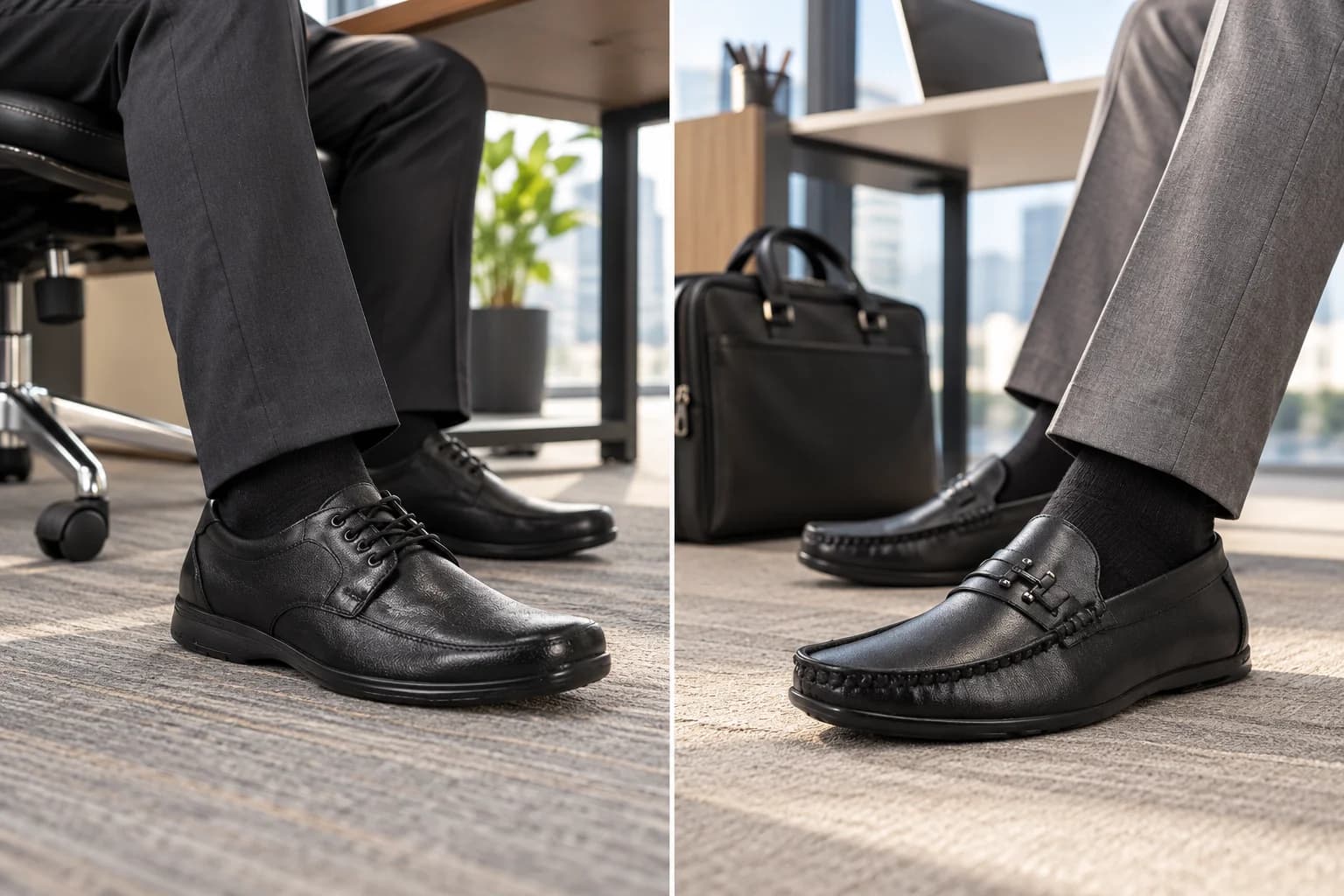
Leather vs Synthetic Leather Shoes: Which Is Better for Everyday Office Wear?
Choosing between leather and synthetic leather shoes is not simply a matter of deciding which material is “better”. Office footwear has to suit the wearer’s routine, budget, local weather, dress code and willingness to maintain it. A pair worn twice a week in an air-conditioned office faces different demands from one used every day for a crowded commute, outdoor walking and long hours at a desk.
Genuine leather is valued for its natural character and its ability to gradually adapt to the foot. Synthetic leather can offer a consistent appearance, straightforward surface cleaning and a more accessible price. Quality and construction vary within both groups, so the material name should be the beginning of the comparison rather than the final decision.
What Is the Difference Between Genuine Leather and Synthetic Leather Shoes?
The main difference is the source and structure of the upper material. Genuine leather comes from animal hide that has been processed for footwear use. Synthetic leather is manufactured to imitate some of leather’s visual and functional qualities, commonly by applying a polymer-based surface to a fabric backing.
This difference influences how the upper bends, responds to moisture, ages and should be maintained. It does not determine the entire quality of a shoe. The lining, stitching, sole, insole, heel structure and overall fit remain equally important.
How genuine leather is made
Animal hide is cleaned, treated and tanned to make it stable and usable. It may then be dyed, finished and given a particular texture. Different leather grades and finishing methods can produce very different results. Some surfaces retain natural variation, while heavily finished leather may look smoother and more uniform.
Leather contains a natural fibre structure. With appropriate use and care, it can soften around normal movement points and develop a distinctive patina. It can also absorb moisture, lose oils, stain or become misshapen when neglected.
Common synthetic materials used in formal shoes
“Synthetic leather” is a broad description rather than one exact material. PU-coated fabric is commonly used because it can provide a smooth formal appearance with relatively low weight. PVC-based and other engineered materials may also be used. Their flexibility, breathability and durability depend on the backing, coating formulation, thickness and construction.
Because formulations differ, two synthetic shoes can perform very differently. Buyers should assess the actual pair instead of assuming that every synthetic upper will behave in the same way.
Leather vs Synthetic Leather Shoes: Key Differences
| Factor | Genuine leather | Synthetic leather |
|---|---|---|
| Initial feel | May feel firm and soften with use | Often feels consistent from the first wear |
| Appearance | Natural variation and gradual patina | Uniform colour and surface finish |
| Breathability | Can allow some moisture transfer, depending on finish | Often less breathable, depending on construction |
| Water response | Can absorb moisture and needs careful drying | Surface may resist light splashes, but seams remain vulnerable |
| Maintenance | Usually benefits from suitable cleaner and conditioner | Commonly cleaned with a lightly damp cloth |
| Ageing | Can crease and develop character | May crease, crack or peel as the coating ages |
| Cost | Often higher, depending on grade and construction | Often more accessible, depending on quality |
| Consistency | Natural marks and tonal variation are possible | Usually offers a more uniform appearance |
These are general tendencies. A well-made synthetic shoe can be more practical than a poorly made leather shoe, and neither material can compensate for incorrect fit.
Which Material Is More Comfortable for Long Office Hours?
Comfort depends first on fit. The shoe should hold the heel without repeated slipping, provide adequate width and leave comfortable room around the toes. It should flex near the natural forefoot bend rather than pressing sharply across the toes.
Leather may gradually shape itself around the foot, which some wearers appreciate during repeated use. That does not mean a tight leather shoe should be purchased in the hope that it will stretch enough. Excessive pressure, numbness or rubbing are signs that the size or shape is unsuitable.
Synthetic leather often provides a predictable fit because the upper changes less with wear. This can be convenient, but a poorly ventilated construction may feel warm during long days. Lining material, sock choice and opportunities to let the shoes air between wears can affect comfort as much as the upper.
For a detailed fit-led checklist, read How to Choose Comfortable Formal Shoes for Long Office Hours.
Which Is Easier to Maintain for Everyday Office Use?
Synthetic leather usually has the simpler basic routine: remove loose dust, wipe gently with a soft damp cloth and dry at room temperature. Avoid soaking the shoe or applying a product merely because it is labelled for genuine leather. Our detailed guide explains how to clean synthetic leather shoes without peeling or cracking.
Genuine leather normally requires more deliberate care. Dust should be removed before cleaning, and any conditioner or polish should be suitable for the particular finish. Products should be tested on a discreet area. Over-conditioning, aggressive rubbing and repeated heavy polishing can be counterproductive.
If a low-maintenance routine is the main priority, synthetic leather may be convenient. If the wearer values natural ageing and is willing to maintain the material, leather may offer greater satisfaction over time.
What Should You Check Before Buying Formal Shoes for Work?
- Confirm the upper material rather than relying on appearance.
- Check whether the shape suits the width of your foot.
- Walk on a clean surface and notice heel movement, pressure and flex.
- Inspect the lining and internal seams for rough areas.
- Consider the full commute, not only time spent seated.
- Check the outsole pattern for the surfaces you regularly use.
- Decide whether the care routine fits your schedule.
- Review product-specific sizing and care instructions.
The Lakhani formal shoes range can help you compare available designs. Verify the material and construction stated for each individual style before deciding.
Which Material Should You Choose?
Choose based on the job the shoe must perform. Genuine leather may suit buyers who value natural texture, gradual adaptation and traditional formal styling. Synthetic leather may suit buyers who prefer a uniform finish, simple surface cleaning and a more accessible everyday option.
For either material, correct fit and sound construction matter more than assumptions attached to the label. A comfortable, appropriate pair that the wearer can maintain consistently is the better office shoe.
Frequently Asked Questions
Are synthetic leather shoes suitable for daily office use?
They can be, provided the fit, lining, flexibility and sole suit the wearer’s routine. Rotate pairs where possible and let them air after use.
Do synthetic shoes require polishing?
They do not generally require conventional leather conditioning. Use only a product stated as suitable for that synthetic surface, and test it discreetly first.
Which material is easier to clean?
Synthetic leather is often easier to wipe clean. Genuine leather may need material-appropriate cleaning and conditioning, especially after repeated exposure to dust or moisture.
Editorial handoff
- Publishing status: Unpublished draft.
- Verification: Materials SME must review all material-performance wording.
- Suggested hero image: Brown leather and black synthetic formal shoes shown side by side.