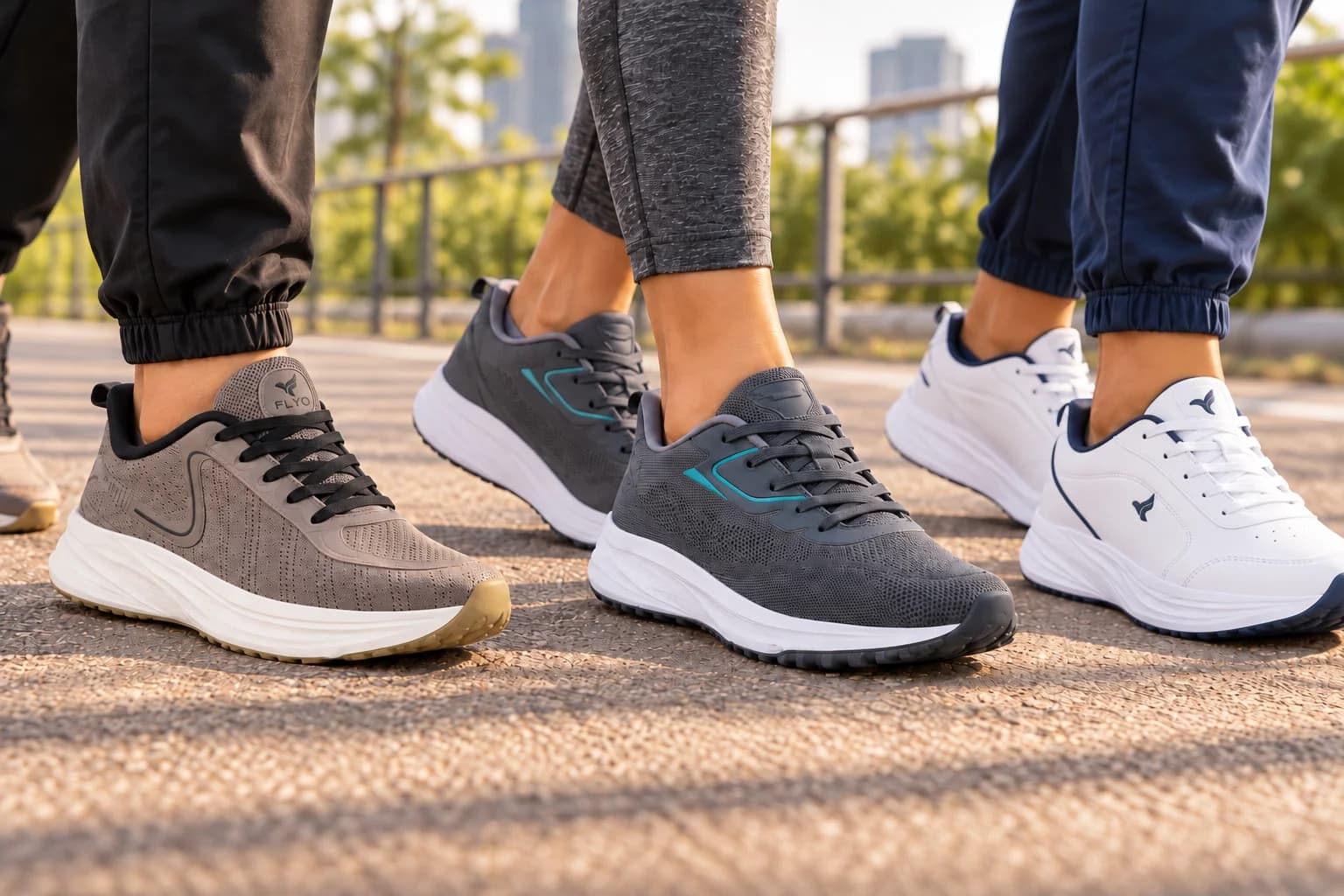
Mesh vs Knitted vs Synthetic Uppers in Sports Shoes
The upper is the part of a shoe that wraps around the top and sides of the foot. In sports shoes, it influences airflow, flexibility, foot hold, weight and cleaning. Mesh, knitted and synthetic uppers can all work well, but they create different balances of ventilation and structure.
Material labels are only a starting point. A tightly woven mesh behaves differently from an open mesh. Knit can be engineered with firmer and softer zones. “Synthetic” covers many materials and constructions. Buyers should therefore examine the whole upper—including overlays, lining, heel counter, toe reinforcement and fastening.
What Is a Shoe Upper and Why Does Its Material Matter?
The upper connects the foot to the sole. It should hold the heel, allow suitable forefoot movement and work with the lacing system to create a secure fit. It also receives repeated stress from bending, perspiration, dust and contact with surrounding objects.
An upper that feels light but does not hold the foot may be unsuitable for active movement. A highly structured upper may feel unnecessarily firm for relaxed daily wear. The right choice depends on activity and individual fit rather than a universal material ranking.
What Are Mesh Sports Shoe Uppers?
Mesh is a woven or knitted textile with visible openings or a porous structure. It is commonly used where ventilation and lower weight are priorities. Mesh panels may be combined with synthetic overlays around the eyelets, toe and heel to add shape and reinforcement.
Open mesh can allow air movement, which may feel comfortable in warm conditions. It can also admit fine dust and is not automatically suitable for rain. The yarn, weave, lining and overlays determine how the upper holds the foot and responds to abrasion.
Mesh should be cleaned gently. Hard brushing can snag fibres, while soaking can leave foam and lining damp long after the surface appears dry.
How Are Knitted Shoe Uppers Different?
A knitted upper is formed from interlocking yarn loops and may be produced as a shaped piece. Different knit zones can provide stretch, ventilation or density without using as many separate panels. This can create a flexible, sock-like feel.
Stretch is not the same as support. Some knitted uppers incorporate tighter zones, internal structures or overlays to help hold the foot. Others prioritise casual comfort. A wearer should test lateral movement and heel security instead of assuming that a close-looking fit is necessarily stable.
Knitted material may conform around irregular foot shapes, but excessive stretch or an unsuitable last can allow movement inside the shoe. Fit should be judged while walking and performing the intended activity.
What Are Synthetic Sports Shoe Uppers?
“Synthetic upper” may describe coated fabric, moulded components, microfibre-like material or combinations of engineered materials. Synthetic panels are often used to add structure, resist abrasion in selected areas or create a particular appearance.
A largely synthetic upper may be easier to wipe clean than open textile mesh, but it may allow less airflow. It is not automatically waterproof. Water can enter through seams, lace openings and the collar even when the surface itself absorbs little moisture.
Synthetic materials vary widely. Flexibility, durability and heat response depend on formulation and thickness, so the individual product specification matters.
Mesh vs Knit vs Synthetic: Breathability, Support and Maintenance
| Factor | Mesh upper | Knitted upper | Synthetic upper |
|---|---|---|---|
| Airflow | Often high, depending on weave and lining | Can be high in open knit zones | Often lower, depending on perforation and design |
| Flexibility | Moderate to high | Often high | Low to high depending on material |
| Foot conformity | Depends on pattern and overlays | Often follows foot shape closely | Usually more structured |
| Support | Frequently relies on overlays | Relies on engineered zones or added structure | Can provide targeted structure |
| Dust resistance | Open structures may admit dust | Open zones may admit dust | Closed surfaces may block more dust |
| Water protection | Not inherently water-resistant | Not inherently water-resistant | Surface may resist splashes; whole shoe may not |
| Cleaning | Gentle brushing and minimal moisture | Gentle cleaning to avoid snagging or stretching | Often wiped clean, if care instructions permit |
| Drying | Can hold water in lining and foam | Yarn and lining may dry slowly | Seams and interior can stay damp despite a dry surface |
Which Upper Suits Walking, Gym Workouts and Daily Wear?
Walking
For everyday walking, look for a secure heel, comfortable forefoot room and an upper that flexes without folding sharply. Mesh can suit warm paved walks, while a structured synthetic or reinforced upper may be useful where abrasion or dust is a concern. Knit may feel comfortable if it holds the foot securely.
Gym workouts
Gym requirements vary. Treadmill walking differs from strength exercises and multi-directional movement. An upper should prevent excessive sliding inside the shoe. Very stretchy knit may not suit every lateral activity, while heavy structure may be unnecessary for straightforward machine work.
Daily wear
For commuting, college or casual use, comfort and maintenance may outweigh specialised performance. Mesh and knit offer a softer visual style; synthetic materials may be easier to wipe after dusty travel. The Lakhani sneakers range offers lifestyle-led alternatives, while the sports shoes category is the relevant starting point for active routines.
How Should You Clean Different Sports Shoe Uppers?
First follow the individual shoe’s care label. Remove dry dirt with a soft brush and take out removable laces or insoles only when permitted.
For mesh, support the fabric from inside and use light pressure. For knit, avoid pulling loops or scrubbing across the yarn. For synthetic surfaces, use a well-wrung cloth and avoid strong solvents. In every case, minimise water, blot moisture and dry in shade with ventilation. Do not use a heater or wear the pair while still damp.
The sports-shoe odour guide explains why proper drying matters after cleaning. The pricing guide also explains how upper construction can influence sports-shoe cost.
What Should You Inspect When Comparing Uppers Online?
Zoom in on the toe, eyelets, side panels and heel rather than judging only the main material. Look for overlays in areas exposed to abrasion and check whether the tongue is padded or thin. A top-down photograph can reveal the opening shape and lacing coverage, while an interior image may show the lining and seams.
Read whether the description identifies the whole upper or only one panel. “Mesh shoe” may still contain substantial synthetic reinforcement, and “knitted upper” does not explain the structure around the heel. Reviews can highlight fit patterns, but another person’s foot shape is not a substitute for measurements and the current size guide.
Frequently Asked Questions
Are mesh shoes suitable for winter?
They can be for mild, dry conditions, but open mesh provides limited protection from cold wind and moisture. Consider local weather and the shoe’s lining.
Do knitted uppers stretch?
Many have some give, but the degree and recovery depend on the yarn and knit structure. Do not buy an incorrectly sized shoe expecting it to stretch into a secure fit.
Are synthetic uppers waterproof?
Not automatically. A surface may resist light splashes while seams, the tongue and collar still allow water to enter.
Editorial handoff
- Publishing status: Unpublished draft.
- Verification: Materials SME should review all comparative material statements.
- Suggested hero image: Three labelled upper swatches beside corresponding shoe silhouettes.