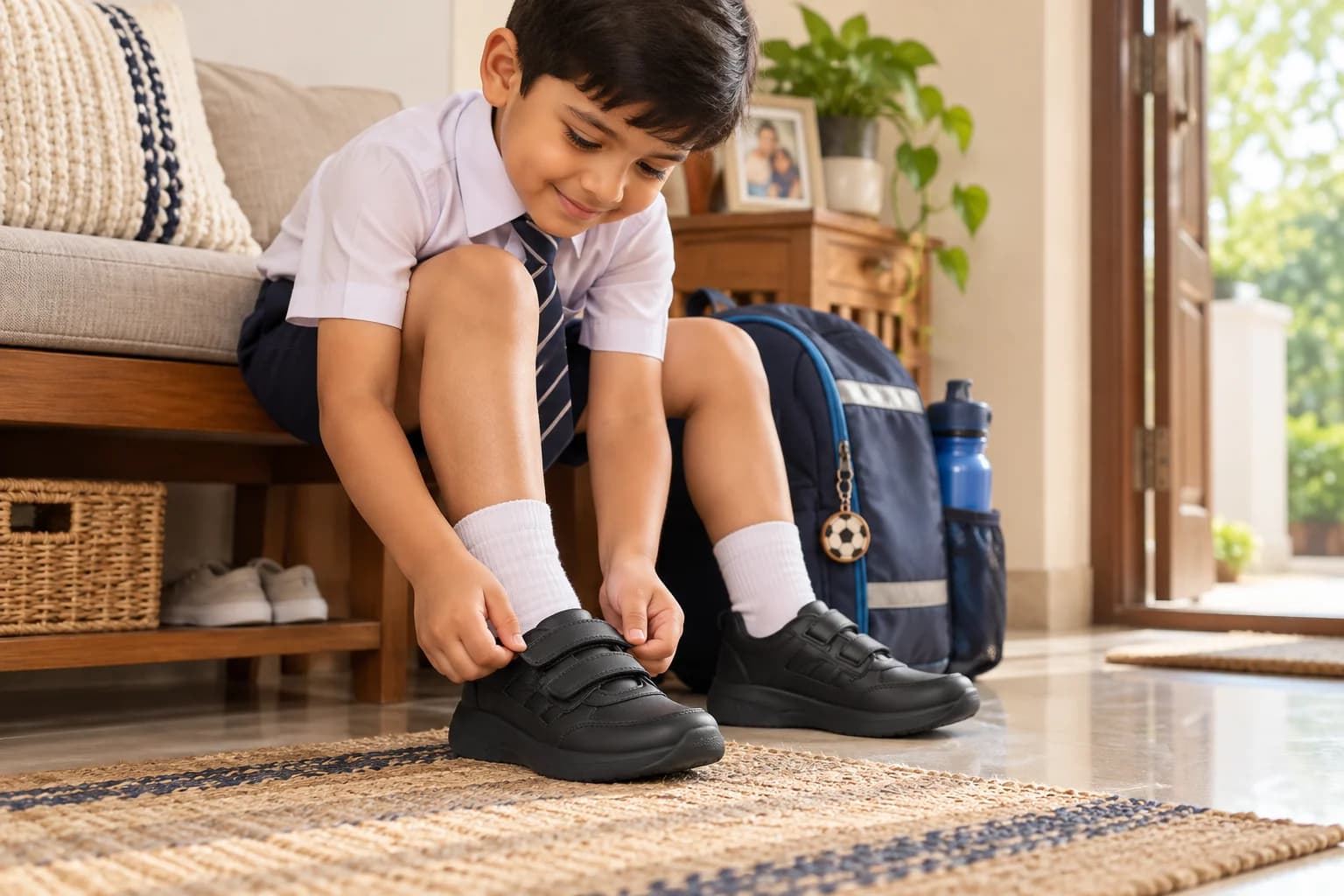
Velcro vs Lace-Up School Shoes: Which Is More Practical?
School-shoe fastening affects more than convenience. It influences how securely the shoe holds the foot, how independently a child can get ready and how easily the fit can be adjusted during a busy school day.
Hook-and-loop shoes—often called Velcro shoes—are quick to open and close. Lace-up shoes offer adjustment across several eyelets but require the child to tie and check the laces reliably. The better choice depends on ability, school rules, foot shape and daily activities rather than age alone.
Velcro vs Lace-Up School Shoes: What Is the Difference?
Hook-and-loop shoes use one or more straps that pass across the foot and attach to a matching surface. A child can usually operate them using one hand, and teachers can quickly see when a strap is open.
Lace-up shoes use cord laces threaded through eyelets. Tension can be distributed across more of the upper, allowing the wearer to adjust different areas. Untied or overly long laces can create a trip hazard, so the child must be able to secure them consistently.
Fastening does not determine the quality of the entire shoe. Both types need correct length, width, heel hold, flexibility and an outsole suited to school surfaces.
Are Velcro School Shoes More Practical for Younger Children?
They often are because the closing action is simple and quick. A child who cannot yet tie laces can put on and remove hook-and-loop shoes independently for school, activity periods or changing rooms. This can reduce reliance on teachers and parents.
However, the child must still learn to pull the strap to an appropriate tension and press it down fully. A loose strap may allow the foot to move; an excessively tight strap can create pressure across the instep.
Check whether the strap is long enough to engage securely without extending far beyond the shoe. Dirt, fibres and repeated use can reduce the grip of the fastening, so it should be inspected and cleaned according to the product instructions.
When Should Children Start Wearing Lace-Up School Shoes?
There is no universal age. A child is ready when they can tie a secure bow, recognise when it has loosened and retie it without repeated adult help. They should also understand not to tuck long loose laces under the foot or continue running with an untied shoe.
Readiness can differ between children of the same age because hand coordination, attention, learning needs and school routine vary. Practising at home before switching school shoes is more useful than setting an age deadline.
School requirements may decide the issue. Some uniforms specify a fastening style, colour or upper type. Confirm the current policy before buying.
Which Fastening Style Is Easier for Daily School Routines?
Hook-and-loop straps are generally faster during rushed mornings and activities that require footwear changes. They can be useful for younger pupils, children who find fine motor tasks difficult or anyone who needs a straightforward fastening.
Laces take longer but may provide more precise adjustment. They can work well for older pupils, long school days and activities where a secure customised hold is useful. The practical advantage disappears if the laces are frequently loose or tied incorrectly.
Consider the complete routine:
- Does the child put on shoes without help?
- Are shoes removed during class or activities?
- Does the timetable include running or physical education?
- Can the child notice and correct a loose fastening?
- Do the shoes need to accommodate an orthotic or another approved insert?
- What does the school uniform policy permit?
How Do Fit, Adjustment and Maintenance Compare?
Fit adjustment
Laces distribute adjustment across several points. This can help accommodate different instep shapes, provided the shoe itself has the correct length and width. One or two straps adjust fewer zones but can still hold the foot effectively when the design suits the child.
Neither fastening corrects a poor size. Tightening a wide shoe until the upper wrinkles can create pressure without stopping heel movement. Loosening an undersized shoe does not create sufficient toe room.
Daily maintenance
Laces can become dirty, frayed or uneven. They are usually replaceable, but replacements should have an appropriate length and shape. Very long laces can trail on the ground.
Hook-and-loop surfaces can collect lint and debris. Clean them gently according to the care instructions; sharp tools may damage the loops. Replace or assess shoes when the strap no longer remains secured during ordinary movement.
Cleaning
Both fastenings should be opened before the upper is cleaned. Remove laces only if they can be rethreaded correctly. Do not saturate hook-and-loop straps, foam or the tongue. The guide to cleaning black school shoes safely explains the wider routine.
What Should Parents Consider Alongside School Uniform Rules?
Uniform compliance is only the first requirement. Parents should also consider the child’s independence, daily walking, school surfaces, weather exposure and fit. If the school allows both fastenings, involve the child in trying them and observe whether they can operate each option correctly.
Check the following while the child is standing and walking:
- Toes have usable room and are not pressed together.
- The heel does not lift repeatedly.
- The widest part of the foot aligns with the shoe.
- The fastening closes securely without extreme tension.
- The upper bends near the natural forefoot flex point.
- The child can walk, turn and use stairs without discomfort.
Do not buy an excessively large pair “for growth”. Extra length can allow sliding and change the flex point. Recheck fit regularly because children may not mention gradual tightness.
Velcro vs Lace-Up School Shoes: Age-Based Decision Guide
Age ranges should be treated as context, not rules. Ability and school requirements are more useful.
| Child’s situation | Hook-and-loop may suit when… | Lace-up may suit when… |
|---|---|---|
| Early school years | The child needs a quick, independent fastening | The child can already tie and monitor laces reliably |
| Developing independence | Simple open-and-close routines build confidence | Lace practice has become consistent at home |
| Frequent shoe changes | Speed and ease are important | Enough time and assistance are available |
| Active school day | Straps remain secure during movement | Laces are tied securely and checked regularly |
| Higher instep or fit variation | Strap design comfortably accommodates the foot | Multi-point adjustment provides a better hold |
| Older pupil | Convenience or motor needs remain relevant | The child prefers and reliably manages laces |
Older children can wear hook-and-loop shoes if the style, size and school rules suit them. Younger children can wear lace-ups when they manage them safely. The decision should remain individual.
How to Test the Fastening Before Buying
Ask the child—not the adult—to open, put on, secure and remove the shoes. Observe whether they pull the tongue into place, use suitable tension and recognise an insecure fastening.
Have them walk, turn, sit and stand again. Recheck whether the strap has lifted or the bow has loosened. Ask where they feel pressure rather than asking only whether the shoe is “comfortable”. Specific questions about toes, heel and instep produce more useful answers.
Explore the Lakhani school shoes category and read How to Choose the Right School Shoes for Children before comparing current styles.
Frequently Asked Questions
Are Velcro school shoes suitable for older children?
Yes. Suitability depends on size availability, fit, personal needs and school rules—not a fixed age limit.
Do lace-up shoes offer better adjustability?
They often allow adjustment across more points of the upper. That advantage matters only when the shoe fits properly and the child ties the laces securely.
How do you know if school shoes fit properly?
Check toe room, width, heel hold and flex while the child stands and walks. The fastening should secure the foot without needing extreme tension.
Editorial handoff
- Publishing status: Unpublished draft.
- Verification: Child-footwear and product reviewers should approve fit and fastening guidance.
- Suggested hero image: One black hook-and-loop school shoe beside one black lace-up school shoe.