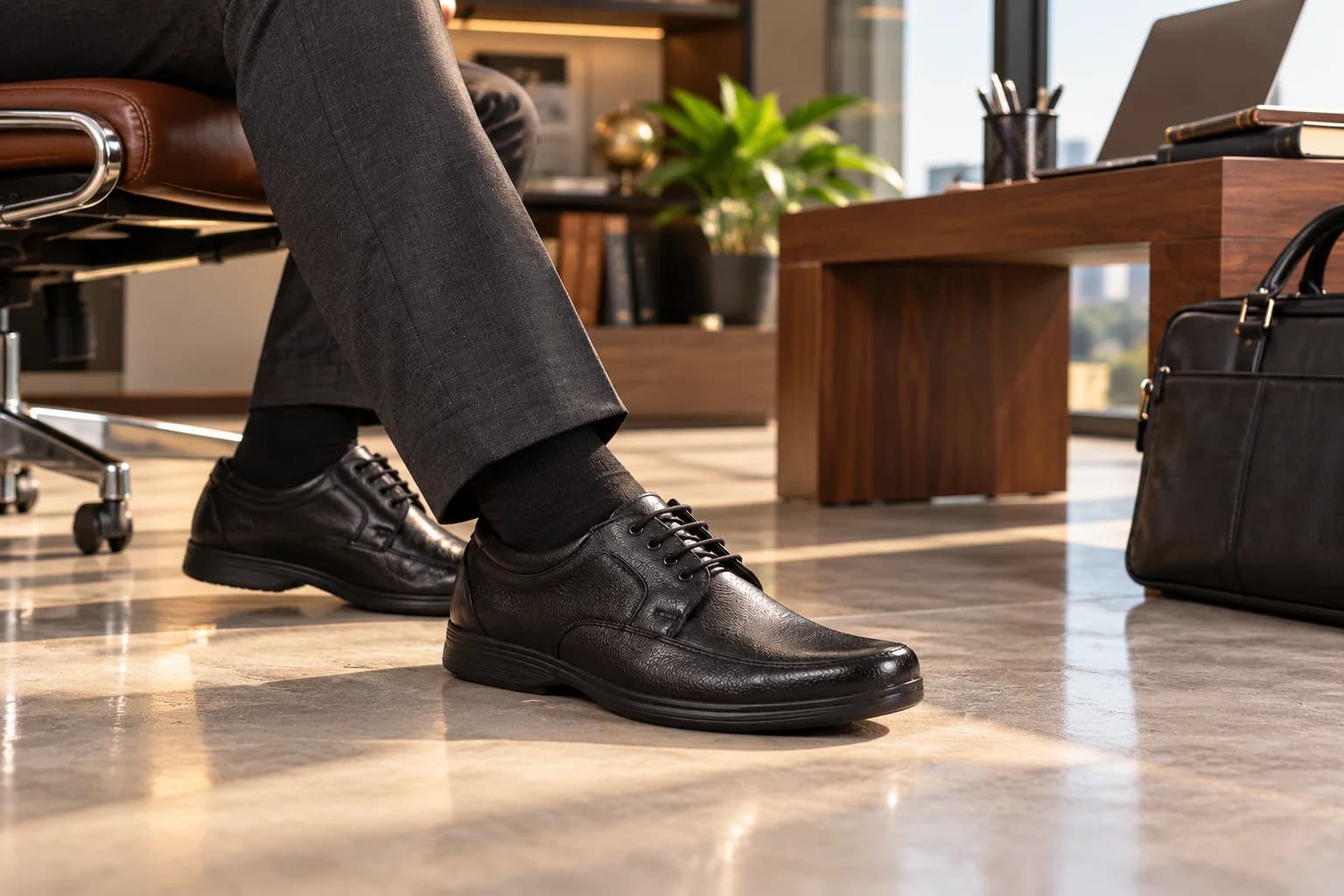
Why Do Formal Shoes Crease? Causes, Prevention and Care Tips
Formal shoes crease because feet bend while walking. When the forefoot flexes, the upper must move with it, creating lines across or beside the toe box. Some creasing is therefore normal and does not mean that a shoe is defective.
The depth, direction and location of those lines can still reveal useful information. Fit, upper material, construction, walking pattern, repeated wear and storage all influence how a pair develops. Understanding those factors helps distinguish ordinary wear from excessive or premature damage.
Why Do Formal Shoes Develop Creases?
During every step, the toes and forefoot bend as the heel rises. The shoe upper compresses above this flex point. Repetition makes the line more visible. A soft upper may form several fine lines; a stiffer surface may form fewer but sharper folds.
No practical formal shoe can remain completely smooth if it is worn and flexed. The realistic goal is to obtain a suitable fit, maintain the upper and prevent avoidable stress—not to eliminate all evidence of movement.
Are Creases Normal in Leather and Synthetic Leather Shoes?
Yes, both can crease, but they may age differently. Genuine leather has an interlocking natural fibre structure. It often develops fine variations and a patina as it bends. Dry or neglected leather may form harsher lines and can crack if its finish and fibres lose flexibility.
Synthetic leather commonly consists of a coated surface over a backing. Repeated bending can mark the coating. With age, heat or unsuitable cleaning, some surfaces may eventually crack or peel along stressed areas. The result depends heavily on the material formulation and shoe construction.
Creasing alone is not proof of low quality. Warning signs include surface separation, cracking through the coating, pain at the flex line or a deep fold caused by visibly excessive space inside the shoe.
What Causes Excessive Creasing Near the Toe Box?
Incorrect fit and flex points
A shoe that is too long can leave excess upper material ahead of the foot’s natural bending point. That material may collapse into deep folds. A shoe that is too wide or too high-volume can also have loose upper material over the forefoot.
A shoe that is too small creates a different problem: it may force the foot and upper to bend under concentrated pressure. Buying a tight pair and expecting it to “break in” is not a dependable solution. The ball of the foot should align reasonably with the shoe’s intended flex zone.
Foot shape matters as well. Two people wearing the same marked size may fill the shoe differently because their instep height, toe shape and width differ. This is why size numbers alone cannot predict creasing.
Repeated wear and storage conditions
Wearing the same pair every day exposes it to continuous flexing before internal moisture has dispersed. Perspiration can leave the upper and lining damp, while accumulated dust can act abrasively around moving areas.
Storage can preserve or distort the shape. Shoes pushed beneath heavy objects, left with the upper collapsed or stored while damp are more likely to retain unwanted folds. Excessive heat and direct sunlight can also affect surface finishes.
How to Reduce Creasing in Formal Shoes
Begin with an appropriate fit
Check fit while standing and walking. The heel should feel secure, the forefoot should not slide excessively and the toes should have usable room. Watch where the upper bends. A natural flex near the ball of the foot is preferable to a sharp fold well ahead of it.
For a full buying checklist, see How to Choose Comfortable Formal Shoes for Long Office Hours.
Rotate your footwear
If possible, avoid wearing the same formal pair on consecutive days. Rotation gives the lining and upper more time to air and recover. It also spreads wear across more than one pair.
Use shoe trees appropriately
A correctly sized shoe tree can help the shoe retain its shape while stored and can soften the appearance of ordinary creases. It should not stretch the upper aggressively. Insert it after wear once any surface dirt has been removed, following the shoe maker’s care advice.
Clean before conditioning
Dust should be removed gently before any care product is applied. For genuine leather, use products intended for the specific finish and avoid over-application. Synthetic uppers need a different routine; our guide to cleaning black synthetic leather shoes explains the precautions.
Walk naturally
Trying to walk stiffly to protect the upper is uncomfortable and unrealistic. Shoes are meant to flex. Concentrate on correct fit and care rather than altering a normal walking pattern.
Can You Remove Creases from Formal Shoes?
Normal creases can often be reduced in appearance, but they cannot always be erased. Begin with the least aggressive method: clean the shoe, allow it to dry naturally and use a suitable shoe tree. Genuine leather may respond to careful conditioning if the product matches the finish.
Avoid internet “hacks” involving irons, hair dryers, direct steam or very hot water. Heat can damage adhesives, finishes and synthetic coatings. It can also dry genuine leather unevenly. Deep structural folds, peeling or cracks may require professional assessment, and some damage cannot be reversed.
Which Shoe-Care Mistakes Make Creasing Worse?
- Buying an incorrect size because the preferred size is unavailable.
- Wearing the same damp pair every day.
- Drying shoes in direct sunlight or beside a heater.
- Using heavy pressure while polishing a flexed area.
- Applying genuine-leather conditioner to an unverified synthetic upper.
- Soaking the shoe during cleaning.
- Storing shoes under weight or with the toe box collapsed.
- Expecting a shoe tree to correct a fundamentally poor fit.
The Lakhani formal shoes collection can be used to compare styles, but the material and care guidance for each individual product should be checked before treatment.
When Is a Crease More Than a Cosmetic Issue?
Inspect the area if a crease creates pressure or rubbing, if the surface has split, or if the upper is separating from another component. A line that changes appearance but does not affect comfort may simply be normal wear. A fold caused by a loose fit can become more pronounced and should prompt a reassessment of sizing for the next purchase.
Frequently Asked Questions
Do shoe trees help reduce creasing?
They can help retain shape and soften the appearance of normal creases during storage. They cannot correct every deep fold or repair cracked material.
Why do new formal shoes crease?
Even a new pair creases as soon as the forefoot bends. Early creasing is not automatically a defect; its location and severity should be considered alongside fit.
Does synthetic leather crease differently?
It can. A synthetic surface may form sharper folds in its coating and may crack or peel as it ages. Results vary by formulation and construction.
Editorial handoff
- Publishing status: Unpublished draft.
- Verification: Materials SME must review care and ageing guidance.
- Suggested hero image: Close-up comparison of normal fine creases and an excessive toe-box fold.